
How Much Energy Would It Take to Destroy a Planet?
Blowing up a planet is a staple of science fiction, but how much energy would it really take? Physics gives a clear answer, and the numbers are staggering.
Destroying vs. damaging
Wiping out life on a planet is relatively “easy” — a large asteroid can do it. Truly destroying a planet means breaking it into pieces and scattering them so far apart that gravity can never pull them back together. The energy needed for that is called the gravitational binding energy.
For a ball of uniform density, it is:
U = 3GM² / 5R
where G is the gravitational constant, M the planet’s mass and R its radius. Because mass is squared, bigger planets get dramatically harder to destroy.
Energy needed for each planet
These are uniform-density estimates. Real planets are denser in the middle, which makes the true values somewhat higher — especially for the gas giants with their compact cores.
| Planet | Binding energy (joules) | Compared with Earth |
|---|---|---|
| Mercury | 1.8 × 1030 | 0.008× |
| Mars | 4.9 × 1030 | 0.02× |
| Venus | 1.6 × 1032 | 0.7× |
| Earth | 2.2 × 1032 | 1× |
| Uranus | 1.2 × 1034 | 53× |
| Neptune | 1.7 × 1034 | 76× |
| Saturn | 2.2 × 1035 | 990× |
| Jupiter | 2.1 × 1036 | 9,200× |
Putting Earth’s number in perspective
Earth’s binding energy of roughly 2 × 1032 joules is hard to imagine, so here are some comparisons:
- The Sun: our star radiates about 3.8 × 1026 watts. Destroying Earth would take about a week of the Sun’s total output — not just the sliver that reaches us, but everything it emits in every direction.
- Nuclear weapons: the Tsar Bomba, the largest bomb ever detonated, released about 2 × 10¹⁷ joules. You would need around a million billion of them.
- The dinosaur-killing asteroid: the Chicxulub impact released somewhere around 1023–1024 joules — devastating for life, but hundreds of millions of times too weak to break the planet.
Why Mars is so much easier than Venus
Mars has about one-tenth of Earth’s mass, and since binding energy scales with mass squared divided by radius, it ends up needing around 45 times less energy than Earth. Venus is almost Earth’s twin in size, so it is nearly as tough.
Could anything natural destroy a planet?
Yes, but only on cosmic scales. A collision with a body of similar size can partly disrupt a planet, and a planet that wanders too close to its star or a giant neighbour can be torn apart by tides. When a star like the Sun dies, it swells into a red giant that may swallow the inner planets. To see what happens when planets hit each other, read what would happen if two planets collided.
Try it (without the physics bill)
In Planet Smash you get a black hole, a supernova, lasers, meteor showers and whole planets to throw — no 1032 joules required. Start with Mercury if you want an easy win, then work your way up to Jupiter.
Frequently asked questions
How much energy does it take to destroy Earth?
About 2 × 10³² joules. That is the gravitational binding energy needed to scatter all of Earth’s material so it never falls back together — roughly a week of the Sun’s entire energy output.
What is the hardest planet to destroy?
Jupiter. Its binding energy is around 10,000 times higher than Earth’s, because it is so massive.
What is the easiest planet to destroy?
Mercury. It is the smallest planet, and needs over 100 times less energy to destroy than Earth.
Could nuclear weapons destroy Earth?
No. All the world’s nuclear weapons combined release far less than a billionth of the energy needed to break the planet apart.
Keep reading
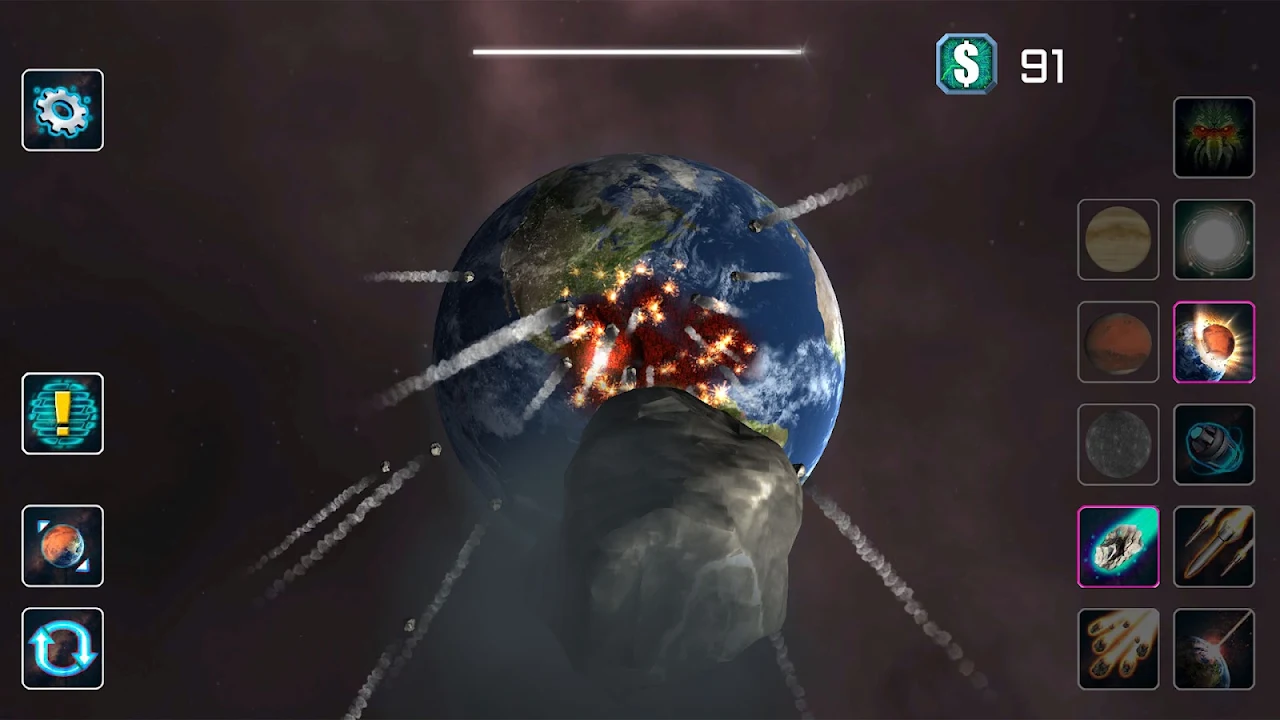 Guide · Planet Smash
What Would Happen If Two Planets Collided?
From the impact that made our Moon to a hypothetical Mars–Earth crash: what really happens when planets collide, how much energy is released and whether it could happen in our solar system.
 Guide · Rocket Spaceflight Simulator
How Do Rockets Reach Orbit? A Beginner’s Guide
Why reaching orbit is about going sideways fast, how much speed it takes, why rockets use stages and what the rocket equation means — with tips for building better rockets in games.