
What Would Happen If Two Planets Collided?
Planets colliding sounds like pure science fiction, but it is one of the most important processes in the history of the solar system. Rocky planets like Earth were assembled from countless collisions, and the last big one may have given us the Moon. Here is what actually happens when two worlds meet.
It has already happened to Earth
The most widely accepted theory of the Moon’s origin is the giant impact hypothesis. About 4.5 billion years ago, a Mars-sized protoplanet — usually called Theia — struck the young Earth at a glancing angle. The impact melted much of both bodies and threw an enormous cloud of molten and vaporized rock into orbit. Over time that debris pulled itself together into the Moon.
The evidence is strong: Moon rocks brought back by Apollo have almost the same oxygen isotope fingerprint as Earth rocks, the Moon has a surprisingly small iron core, and its surface shows signs of having once been a global ocean of magma.
What decides the outcome of a collision?
Not every planetary collision ends the same way. Computer simulations show four broad outcomes, depending on the size of the bodies, their speed and the angle of impact:
- Merger — slow, head-on impacts where the two bodies fuse into a single larger planet.
- Hit-and-run — a grazing blow where the smaller body is stretched, stripped and flung onwards, often badly damaged.
- Erosion or disruption — fast impacts that blast away a large fraction of the target’s mass.
- Debris disk — material sprayed into orbit that can form moons or rings, as with Earth and the Moon.
What if Mars hit Earth today?
Mars has about one-tenth of Earth’s mass and just over half its diameter. Even if it simply fell together with Earth from a standstill, the two would meet at around 10–11 km/s — roughly Earth’s escape velocity. That works out to an impact energy of around 4 × 1031 joules, more than the Sun delivers to Earth in a million years.
Earth would not be blown apart: completely dispersing our planet takes about 2 × 1032 joules, several times more (we break that number down in our article on how much energy it takes to destroy a planet). But the surface would be destroyed. The crust would melt into a global magma ocean, the oceans would boil away and a large part of the atmosphere would be stripped into space. Much of Mars would end up merged into Earth, and some of the debris might form a new ring or moon.
Torn apart before impact: the Roche limit
A smaller body does not always reach the surface intact. If a moon or small planet drifts within the Roche limit — roughly 2.4 times the larger planet’s radius for a fluid body — tidal forces pull it apart faster than its own gravity can hold it together. The result is a ring rather than a crater. Some scientists think Saturn’s rings may have formed this way.
Could planets collide in our solar system?
Not any time soon. The planets’ orbits are stable over billions of years. The main exception is Mercury: long-term simulations by Jacques Laskar and colleagues found roughly a 1% chance that Mercury’s orbit becomes chaotic within the next five billion years, which in some runs leads to a collision with Venus, the Sun or even Earth.
We have seen it happen around other stars
Astronomers have found the aftermath of giant impacts elsewhere in the galaxy. In 2023, a team reported that the star ASASSN-21qj brightened in infrared and then dimmed — best explained by two ice-rich planets colliding and producing a glowing, expanding cloud of debris that later passed in front of the star.
Myth: the asteroid belt is a smashed planet
It is a popular idea, but the asteroid belt is not the wreckage of a destroyed planet. Its total mass is only about 3% of the Moon’s. It is leftover material that never managed to form a planet, mostly because Jupiter’s gravity kept stirring it up.
See it for yourself
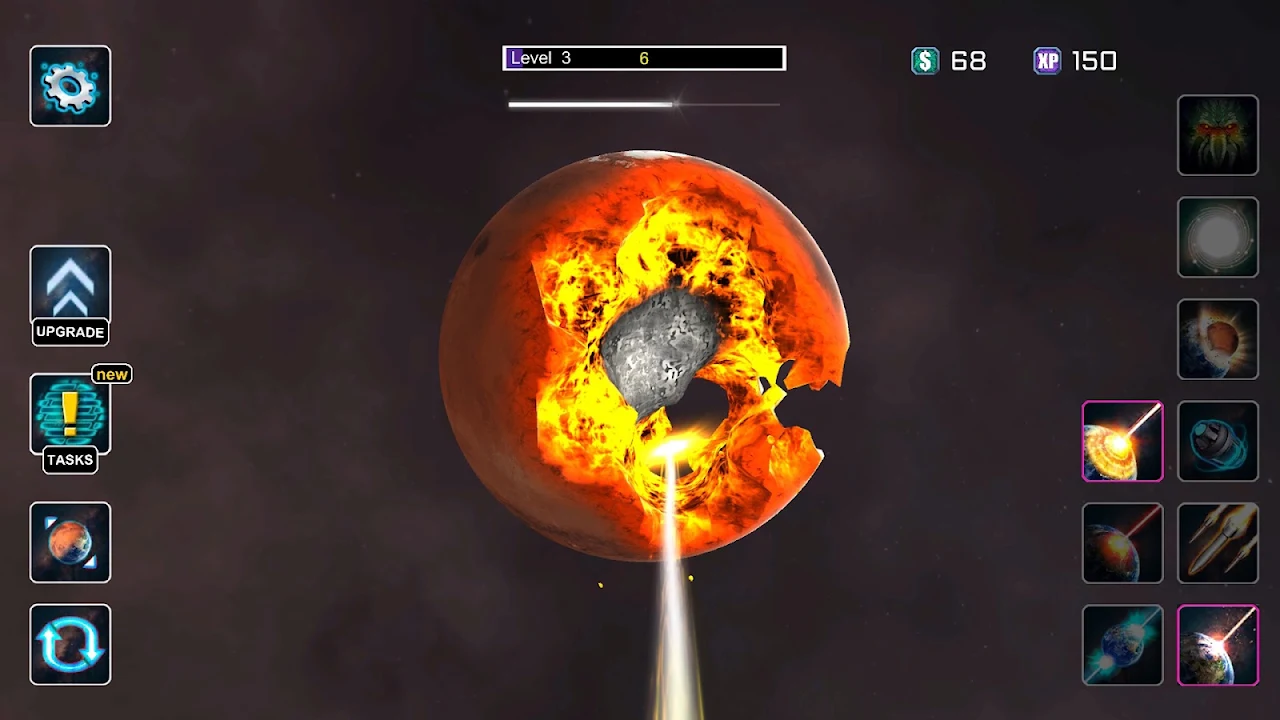
You cannot crash real planets, but you can do the next best thing. In Planet Smash you can grab Mars or Venus and throw it straight at Earth, then watch the crust crack, the core glow and the debris settle into orbit. It is a game rather than a scientific simulation — but it is a very satisfying way to picture a giant impact.
Frequently asked questions
Has Earth ever collided with another planet?
Very likely, yes. The leading explanation for the Moon’s origin is that a Mars-sized body called Theia hit the young Earth about 4.5 billion years ago, and the Moon formed from the debris.
Would Earth survive a collision with Mars?
Earth would survive as a planet, because the impact energy is only a fraction of what is needed to blow Earth apart. But the surface would melt into a magma ocean and nothing on it would survive.
Could planets in our solar system collide in the future?
It is very unlikely. Simulations suggest roughly a 1% chance that Mercury’s orbit becomes unstable over the next five billion years, which could eventually lead to a collision with Venus or Earth.
Is the asteroid belt a destroyed planet?
No. The asteroid belt’s total mass is only about 3% of the Moon’s. It is material that never formed a planet, largely because of Jupiter’s gravity.
Keep reading
 Guide · Planet Smash
How Much Energy Would It Take to Destroy a Planet?
How much energy it takes to completely destroy Earth, Mars, Jupiter and every other planet, explained with gravitational binding energy and easy comparisons.
 Guide · Rocket Spaceflight Simulator
How Do Rockets Reach Orbit? A Beginner’s Guide
Why reaching orbit is about going sideways fast, how much speed it takes, why rockets use stages and what the rocket equation means — with tips for building better rockets in games.